Disclosure: This post contains affiliate links. As an Amazon Associate I earn from qualifying purchases — at no extra cost to you. I only recommend products I genuinely believe in as a pediatric physical therapist.
As a pediatric physical therapist, one of the most common questions I get from parents is: "What toys should I buy to help my child develop?" It's such a great question — and the answer might surprise you.
The best developmental toys aren't always the flashiest or most expensive. They're the ones that invite movement, challenge balance, build strength, and make kids want to get off the couch. Below, I've broken down my top picks by age group so you can shop with confidence, knowing exactly what skill each toy is targeting and why.
Note: As an affiliate, I may earn a small commission on purchases made through the links below — at no extra cost to you. I only recommend products I would genuinely use with my own patients and kids!
Babies
0 – 12 MonthsIn the first year, gross motor development is all about building the foundational strength to hold the head up, roll, sit, and eventually pull to stand. The name of the game is floor time — especially tummy time. The toys below make floor play irresistible.
Tummy Time Mat & Pillow

A wedge-shaped tummy time pillow props baby at a slight incline, making it easier for newborns to lift and hold their head — which directly builds the neck and upper back muscles needed for every milestone that follows. A bright, contrasting play mat underneath gives babies something visually engaging to motivate that hard work. I recommend starting tummy time from day one, even if it's just 2–3 minutes at a time.
⚠️ Safety note: Tummy time should always be supervised. Never leave baby unattended on a tummy time pillow, and never use it for sleep.
Shop on AmazonO-Ball Rattle

This is one of the most bang-for-your-buck toys out there. The lightweight, open-lattice design makes it easy for tiny hands to grip and explore. In tummy time, it encourages babies to shift weight onto one arm and reach — an important precursor to crawling. The rattle sound motivates rolling as babies track the toy. Simple, safe, and endlessly useful across the first year.
Shop on AmazonBaby Activity Gym / Play Gym

A well-designed play gym is one of the most versatile investments for the first six months. Hanging toys motivate babies to reach and kick — building core and hip flexor strength — and the visual stimulation encourages head turning that supports neck muscle balance. Look for one that can be used in both back-lying and tummy time positions. Bonus: many convert into a mat as baby grows.
Shop on AmazonBabies don't need seats, bouncers, or jumpers to develop — they need floor time. Save the containers for when you genuinely need your hands free, but aim for the majority of awake time to be on a flat surface where baby can move freely and build strength.
Young Toddlers
12 – 24 MonthsThis is the year of big milestones: first steps, climbing, squatting to pick things up, and learning to run (even if it looks a little wobbly!). Toys that encourage cruising, pushing, climbing, and throwing are your best bet here.
Push Walker (e.g. VTech Sit-to-Stand Walker)

A push walker gives new walkers the confidence boost they need without doing the work for them. Unlike a ring-sitting walker (which I'd steer clear of), a push walker requires your child to bear their own weight and control their own balance — it just provides a light point of external support while they figure out the coordination of walking. Look for one that has some resistance so it doesn't roll away too fast.
Shop on AmazonSoft Play Climber / Foam Climbing Set

Foam climbers are basically a mini PT gym for your living room. Climbing up, over, and around different heights builds tremendous core and upper body strength, and challenges motor planning — the brain's ability to figure out how to move the body through space. This is one of the most clinically valuable toys for this age group. Look for sets with a small slide, ramp, and arch to maximize variety.
Shop on AmazonPlay Couch / Couch Cushion Obstacle Course

A modular play couch (like the Nugget) is endlessly reconfigurable — ramp, slide, fort, crash pad, climbing mountain — making it one of the most versatile gross motor tools you can have in your home. The foam provides proprioceptive feedback as kids climb, jump, and roll, which is deeply regulating for the sensory system. Don't want to spend the money? Pull the cushions off your own couch. Seriously — couch cushions on the floor are one of my favorite low-cost tools for obstacle courses, rolling practice, and safe crash landings. The developmental value is identical.
Shop Nugget Play CouchRubber Playground Balls (Various Sizes)

Never underestimate the humble ball. Rolling, throwing, chasing, and kicking works almost every gross motor skill simultaneously — weight shifting, balance, coordination, and bilateral body awareness. I recommend solid rubber playground-style balls over foam for this age group, since foam can be bitten into and poses a choking risk. Rubber balls in varied sizes (4", 6", 8") help toddlers develop different grip patterns and keep things interesting. Kicking also builds the single-leg stance needed for stair climbing and running.
Shop on AmazonAvoid ring-style baby walkers (the ones babies sit inside). Despite being heavily marketed, they are associated with delayed walking and have been banned in Canada. They reduce floor time, don't allow babies to feel natural weight-shift, and are a significant safety hazard.
Older Toddlers & Preschoolers
2 – 5 YearsBy age two, kids are walking confidently and starting to run, jump, hop, and climb. Now the focus shifts to refining coordination, building endurance, and challenging balance — and importantly, giving the sensory system what it needs to stay regulated. This age group thrives on active, dynamic, full-body play.
Trampoline — Mini with Handle Bar or Enclosed with Safety Net
 Mini with Handle Bar
 Enclosed with Safety Net
Jumping is one of the most powerful gross motor milestones — and a trampoline makes it accessible and safe indoors. The repetitive bouncing provides deep proprioceptive (joint-position) input to the whole body, which is incredibly regulating for the nervous system. Kids who seem "wild" or dysregulated often benefit enormously from trampoline time before demanding tasks.
Two great options depending on your space and budget:
🔵 Mini trampoline with a handle bar — compact, fits in any room, and the stability bar supports children who are still developing the leg strength and balance to jump with both feet. Great for smaller spaces and younger jumpers.
🟢 Enclosed trampoline with a safety net and bar — a larger jumping surface with a mesh enclosure around the outside and a bar to hold onto. The net means kids can bounce freely without the risk of bouncing off the edge, making it a great option for more enthusiastic or older jumpers. These typically fold flat for storage.
Pikler Triangle

The Pikler Triangle (sometimes called a climbing triangle) is rooted in the Pikler approach to infant and toddler development — the idea that children should be allowed to move and explore freely at their own pace. As a PT, I love it because climbing challenges the whole body: grip strength, shoulder stability, core control, hip flexor strength, and serious motor planning as kids figure out where to put each hand and foot. It also gives children the opportunity to assess and manage their own risk — an underrated developmental skill. Many sets include a ramp with rungs for sliding, adding even more variety. It grows with children from about 18 months through early school age.
⚠️ Safety note: Always supervise your child closely while they use a Pikler triangle. Never leave them to climb unsupervised — a parent or caregiver should be within arm's reach at all times, especially with younger or less experienced climbers.
Shop on AmazonPop-Up Play Tunnel

Don't be fooled by the age label — tunnels are fantastic for kids well beyond the crawling stage. Crawling through a tunnel with an obstacle (like a pillow) placed inside challenges upper body and core strength, bilateral coordination, and the motor planning required to navigate a confined space. For older kids, try bending the tunnel into an "S" shape or partially flattening it for extra challenge. One of my most-used tools in sessions.
Shop on AmazonBalance Stepping Stones & Balance Beam
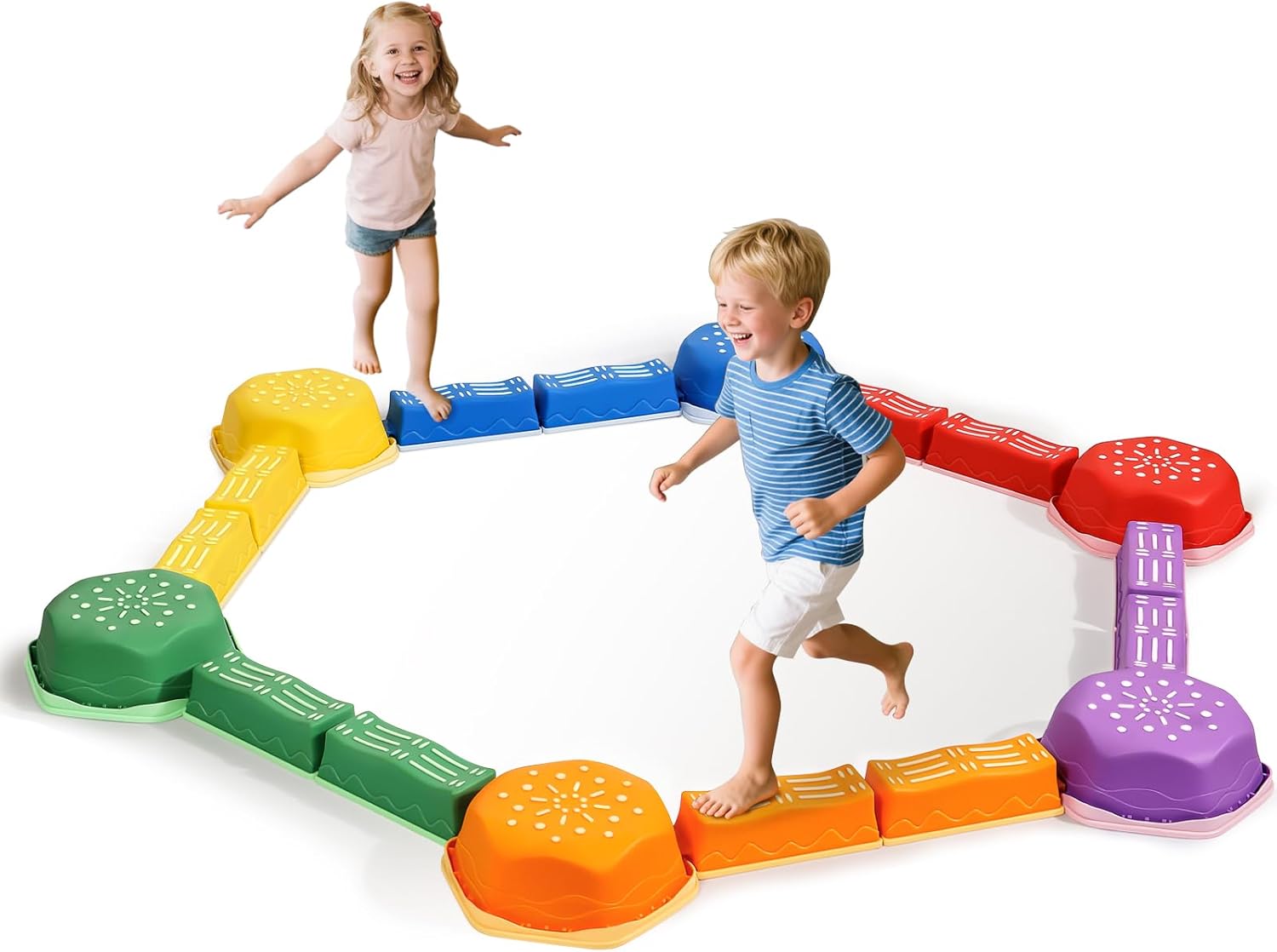
Balance stepping stones are deceptively simple and incredibly effective. Stepping from stone to stone at different heights challenges single-leg balance, ankle stability, and the visual-motor coordination needed to judge distances. These are great for kids who tend to trip, stumble, or struggle with uneven terrain outdoors. Set them up in a line, circle, or obstacle course to keep things fresh.
A balance beam is a fantastic add-on or alternative — walking heel-to-toe along a raised beam builds the same single-leg balance and ankle stability in a more focused, linear way. Many sets combine stepping stones and a beam together, giving you a versatile indoor obstacle course in one purchase. Both are tools I use regularly in sessions.
Shop on AmazonStomp Rocket

A stomp rocket is one of those toys that's pure joy — and it happens to be excellent for gross motor development. To launch the rocket, kids have to jump or stomp with full-body force, which requires bilateral coordination, midline crossing, and significant proprioceptive input through the legs and feet. It's a fantastic outlet for kids who need heavy work input, and the cause-and-effect (stomp → rocket flies!) is incredibly motivating for all ages. A great excuse to get outside and move big.
💡 PT tip: Try having your child stomp with one foot at a time rather than both — this turns the stomp rocket into a single-leg balance challenge too! Standing on one leg while stomping down with the other requires the standing leg to stabilize the whole body, which is great practice for balance, core control, and hip strength.
Shop on AmazonBalance Bike

Balance bikes are one of the best investments you can make for a 2–4 year old. By removing the pedals entirely, children learn the hardest part of biking first — balance — without the confusion of trying to pedal at the same time. Kids who learn on balance bikes almost universally transition to a pedal bike without training wheels. It also builds enormous core strength and leg endurance. Look for a lightweight model with a low seat height so feet can touch the ground flat.
Shop on AmazonScreen time and sedentary containers limit the movement variety children need. The American Academy of Pediatrics recommends at least 3 hours of physical activity daily for toddlers — and the good news is it doesn't need to be structured. Active play with the right toys absolutely counts!
You don't need to spend a fortune — many of the best gross motor activities are completely free (stairs, hills, playgrounds, pillows on the floor). These toys simply add variety and motivation at home. The best toy is always the one your child is excited about!
If you have concerns about your child's motor development, please reach out. Early intervention makes a real difference, and I'm always happy to chat.
Questions About Your Child's Development?
I offer mobile pediatric PT evaluations throughout Madison and Onondaga Counties. Let's see your child in their natural environment — where they learn and play best.
Get In Touch →Medical Disclaimer: This blog is for educational purposes only and does not constitute medical advice. If you have concerns about your child's development, please consult with a licensed pediatric physical therapist or your child's pediatrician.